First published on TimAtkin.com
This article was first published on TimAtkin.com on 18 February 2026
Read this and other stories on Tim's website here.
New Zealand winemakers have blazed a trail across the global white wine landscape with Sauvignon Blanc. Now the country’s most planted red grape, Pinot Noir, is demonstrating equally compelling potential, despite its comparatively short history.
In terms of scale, Pinot Noir is still overshadowed by New Zealand’s dominant white grape, of course. Sauvignon Blanc commands 28,702 hectares (67% of the country’s 42,520 hectares) and accounts for more than 85% of exports. Pinot’s paler colour is matched by its more modest footprint of 5,331 hectares. But it has grown exponentially since 1989, when 138 hectares were officially recorded by the country’s industry body, NZ Winegrowers, for the first time. What’s more, some of those earliest examples are every bit as characterful, regionally‑expressive and varietally pure as the pioneering whites of the same era.
The evolution of New Zealand Pinot Noir was encapsulated by a 34‑vintage retrospective I attended late last year at Ata Rangi, one of the country’s benchmark producers. The tasting posed two critical questions: how well does New Zealand Pinot Noir age and what resemblance, if any, does aged Kiwi Pinot Noir bear to red Burgundy?
The retrospective tasting was a private, invitation‑only event co-hosted by winemaker Helen Masters and Martinborough collector John Penney, who cellared most of the wines in impeccable condition. Masters made nearly all of the wines we tasted. And, notably, all but the first two – 1991 and 2000 – were sealed under screwcap, reflecting the decisive shift in closures that has swept New Zealand since 2001.
Set against a lone Burgundy brought by one of the tasters, the Ata Rangi wines presented a markedly different stylistic profile. Their structural integrity revealed a consistency across three and a half decades, suggesting that, from those early days, Martinborough Pinot Noir had potential longevity, provided the wines were made with thoughtful attention to cropping and production. The oldest wine was the favourite for many, proving that the best New Zealand Pinot Noirs have stood the test of time.
Are Martinborough and Ata Rangi typical of what’s going on elsewhere in New Zealand? Or are they the exception to the rule? To find some answers, I spoke to some top Pinot Noir producers in other parts of the country.
I began in Central Otago, one of the world’s southernmost wine regions. Over 80% of this varied vineyard area is devoted to the great moody red Burgundian grape and Felton Road was one of the first wineries to produce it. Winemaker Blair Walter says candidly that it’s hard to make definitive conclusions about Pinot Noir’s ability to age in the early days of such a young wine region. “There are no decades of history to witness vintages dating back to the 1960s and 1970s, let alone earlier,” he says.
Looking back at earlier vintages from the 1990s, he says the wines often aged relatively rapidly. He attributes this mostly to young vineyards. “Wines made from young vines have skinny trunks, small root systems and lack proper canopies.” Back then, young Pinot Noir vines across New Zealand often offered wines that were fruity and attractive in their youth but did not always have the material (mainly grape tannin) to age gracefully. Now both the vines and vineyard practices have matured across the country.
Felton Road is now fully organically certified and adheres to biodynamic viticultural practices, producing some of New Zealand’s most highly sought after Pinot Noirs from four distinctly different sites, which are demonstrably showing positive ageing potential.
The same can be said of a handful of wineries approximately halfway up the South Island – in North Canterbury, where Pegasus Bay Winery is based. This company is owned by the Donaldson family, who have observed a notable shift in how their wines evolve. “Pinot Noir from this part of the country is ageing more slowly and gracefully than in the past, revealing a regional capacity for longevity that continues to strengthen,” says Ed Donaldson.
The winery has spent nearly two decades testing the potential longevity of its wines, deliberately holding back small volumes of Pinot Noir (and Riesling) for a decade. The initiative began with the 2006 vintage, which was released in May 2016. It has continued ever since with an annual release of ten-year-old wines. As time goes by, the aged releases have improved in complexity and balance. This is, in part, a reflection of changing vineyard and winery practices, with harvest dates now typically one to two weeks ahead of harvest dates ten to 15 years ago. Another factor is the typically higher proportion of whole bunch fermentation used today.
Discussing Pinot Noir’s ageability over the brief history of the grape in New Zealand turns up a raft of philosophies about how Pinot Noir has aged – and is ageing now. The country’s cool climate always gave its Pinots a head start, but the wines are much better now than they were 30 years ago. The heavy-handed extraction of some of the early Kiwi Pinots has mostly given way to more confident, reactive winemaking that reflects the season rather than a penchant for winemaking tools.
Another Martinborough winemaker, Tim Bourne from Escarpment Vineyard, sees Pinot Noir as a window into the vineyard as well as a reflection of the season in which it was grown. “In warm seasons with riper fruit, we can be a bit heavier handed in some areas but also back off in others. In cooler, more delicate years, we operate more gently on the fruit than in the past.”
The past five years have been a sobering reminder of extremes in Martinborough and the wider Wairarapa region, in which it is situated at the southern tip of the North Island. The 2020 vintage had a long, dry Indian summer, which was followed by a small harvest in 2021 with wines showing impressive concentration. Then there were torrential rains in 2022 followed by cyclones in 2023. Business as usual is an elusive concept these days and there is no one-size-fits-all approach, particularly when it comes to ageing potential for wines from such challenging years.
Bourne is an advocate of dialling winemaking back with less plunging and extraction “because we get extraction anyway due to the high winds and low crop volumes in this region. I also think today’s wine drinkers expect wines to be delicious from the get-go. Many people don’t want to wait 20 years for their wines to mature.”
Back in the deep south, Central Otago winemaker Matt Dicey of Dicey Wines says that each block of Pinot Noir needs to be treated differently and that less is more is not necessarily the best approach. A more nuanced response works best, he feels.
Challenging years can lead to some of the best innovations. Prior to Helen Masters’ arrival, whole bunch fermentation typically made up 10% of the production of Pinot Noir at Ata Rangi. The big turning point was 2017. This cool vintage forced a rethink, and Masters decided to increase the percentage of whole bunch fermentation to enhance the structure of her wines. This worked so well that now she uses about 40% of whole cluster fermentation.
So where does New Zealand Pinot Noir stand now? It’s still a work in progress, no doubt, but overall, it has moved from the fruit forward styles of the early days to more savoury, complex wines, at least at the top end. Some of the first Pinots did reveal the classic forest floor-type aromas that set the benchmark globally for great Pinot Noir, as that Ata Rangi tasting proved, but they were rare.
Progress has been swift over the relatively short period of time that Pinot Noir has been produced here. One of the biggest changes has been the in-depth understanding of differing weather patterns across the country. The key regions are Central Otago, North Canterbury, Nelson, Marlborough and Martinborough.
In North Canterbury and Martinborough strong spring winds are a defining feature of bunch architecture, leading to wines with noticeable tannin structure. On the other side of the coin, Central Otago has an extraordinary range of different sub-regions, sites and weather patterns, which are continuously being examined by winemakers who have collectively worked together to spear head their region’s reputation.
It’s coming up to 40 years since Pinot first appeared in New Zealand Winegrowers’ annual statistics, but the consistency, quality and range of regional styles that are emerging across the country point to a promising future, for those prepared to respond to what their vines and the growing season give them each year.
The last word goes to one of the first winemakers in Central Otago, Rudi Bauer, who is a biodynamic and certified organic producer of Pinot Noir (and other varieties). “More emphasis on rootstock selection, increase of organic matter, collective marketing and impact of a second generation have all led to more restrained styles of Pinot Noir today,” he says. “There is now an inner confidence of viticulturist and winemaker to faithfully reflect the vineyard in the glass each vintage.” I’m happy to drink to that.
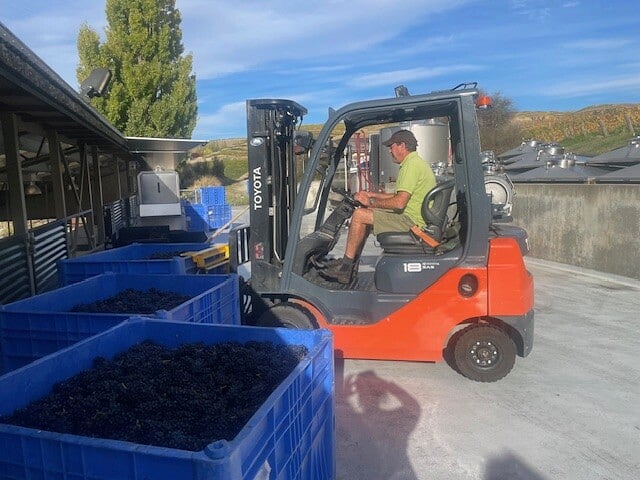
Blair Walter brings in Pinot Noir (in this picture, the Abel clone) during the 2025 harvest. (The original published story features a picture of Blair taken by Tim Atkin.)