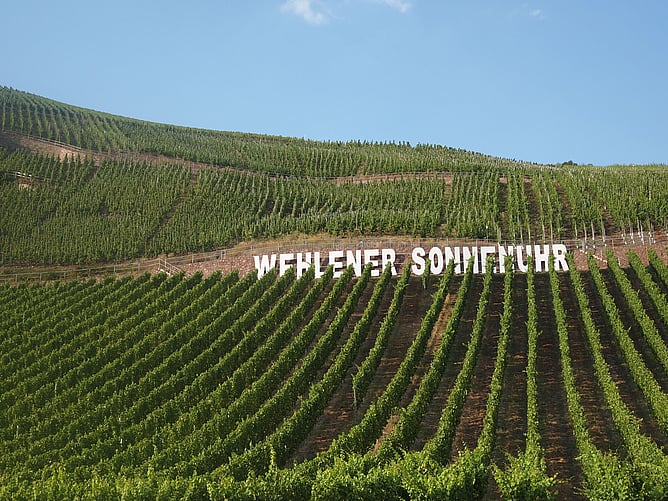
"You have to be a mountain goat to work on these slopes," said Dr Ernst Loosen when speaking to a packed room of wine devotees in Wellington last month.
Dr Loosen (as the eponymous wines of this winemaker are known - pronounced 'low-zen') is one of the wine world's most articulate ambassadors. The slopes in question are impossibly steep, blanketed in vines as they flank the banks of the Mosel River in Germany's most famous wine region; the Mosel.
There are places that leave a positive impression and then there are places that provoke an existential sense of awe. The Mosel is firmly in the latter category.
Vines grow there with a defiant sense of survival against the odds, clinging to slopes that reject any notion of man made cultivation and appear to suggest that harvesting by hand would mean risking life and limb in the process. And yet the steepest slopes are harvested by hand as they wind their way around the Mosel River's unpredictable twists and turns. They are mostly Riesling, which was the sole subject of several tastings that Loosen hosted in Wellington in February.
The tasting that I attended was a paid event at Regional Wines & Spirits and Loosen captivated the room with his quirky sense of humour and classic German Rieslings from dry to medium dry to sweet with a story to tell for each style.
There are two winemaking traditions in the Loosen family and, when Ernie took over the estate in 1988, the predominant style was for lightly sweet Mosel Rieslings - his grandmother's preference. He later learned that his paternal great grandfather, Peter Loosen, made only dry Rieslings and believed that sweetness was a flaw - so much so that he sold off any wines that had not fermented to dryness.
Since the 1990s, Ernie has made both styles; experimenting with the Pradikat system (where wines are made in a hierarchy based on the sweetness in the grapes at harvest), which characterised his maternal winemaking lineage.
There are merits both ways; in wines containing sweetness (balanced by Riesling's naturally high acidity) and in dry wines. The majority of both are low in alcohol, without adopting practices that verge on distasteful - by which, I mean the removal of alcohol; a practice that serves very little benefit when making classic wine styles.
The Mosel's geography, heat and human hand
The Mosel sits at roughly 100 metres above sea level, with its highest vineyards reaching up to 300 metres. In a region this cool, slopes are everything. The steeper the incline, the more heat the vines absorb; the more direct the southern exposure, the more viable the fruit flavours. North‑facing slopes are considered poor quality and serve as a reminder that in the Mosel (as everywhere) nature offers no guarantees.
Many of the vineyards here were carved into cliff faces up to 800 years ago. Today they remain among the steepest on earth. In 2020, Loosen purchased what is widely regarded as the steepest of them all: the 1.1‑hectare Kaimont GG Reserve, with a staggering 130% gradient.
“Sometimes I have to admit after six years that it has frustratingly low crops with low yields.”
The wine stays two to three years in barrel without bâtonnage - as was common practice 120 to 130 years ago - and is bottled without fining or filtering, then held in stainless steel for five years.
Climate change has shifted the region from the historical pattern of “three good vintages per decade” to far greater consistency, both in ripeness and quality.
Classification, soil and history
An 1868 Saar and Mosel Weinbau‑Karte divided vineyards into first, second and third growths - the latter was roughly equivalent to Burgundy’s village level. Only first‑growth sites appear on labels; lower classifications list soil type instead, hence Dr Loosen Red Slate Dry Riesling.
Slate dominates the region’s soils and is also the reason the Mosel remains home to ungrafted vines, which are up to 150 years old, untouched by phylloxera.
Loosen is a long‑standing member of the VDP (Verband Deutscher Prädikatsweingüter); the region's voluntary wine body that encapsulates and promotes high quality winemaking practices. When Ernie plants vines on a grand cru site, he waits 30 to 35 years before producing wine from it.
Another quality measure he takes is eschewing the option of adding up to 25% of other grape varieties in any wine, which is permitted by EU law. Loosen refuses this option so that every wine he makes is 100% Riesling.
Closures: A pragmatic philosophy
The family's wine production in the 1960s had about two to three per cent cork taint, a figure which has dropped significantly today. Loosen opts for closures according to market preference, sealing the majority of his wines at higher prices under cork and choosing screw cap for lower priced wines.
All Rieslings made from estate grown grapes are fermented with indigenous yeasts and, like all quality focussed Riesling producers, acidity is key, he says. because that's where the balance, the vibrancy and the life in his wines comes from.
Top picks for the cellar - and for now
I wrote extensive notes on all wines tasted at this exceptional event. Here are my top picks.
2023 Dr Loosen Red Slate Riesling Dry RRP $37.99
Red slate delivers lifted fragrant floral aromatics and a firm, linear acid structure, which carries each refreshing sip to a lingering, memorable finish. This is drinking beautifully now - a great match with Thai lemongrass infused flavours - but it's got time up its sleeve. I've got half a dozen bottles in my cellar and looking forward to enjoying them in two to three years.
2020 Dr Loosen Kinheimer Rosenberg Riesling GG Dry RRP $66.99
Grand cru sites are always named after the village and the site; in this case Kinheim is the village and Rosenberg (“rose hill”) is the name of the vineyard. Zingy lemongrass, concentrated thyme and lemon zest sit in a weighty, dry wine with lees‑derived texture and impressive weight.
2020 Dr Loosen Wehlener Sonnenuhr Riesling GG Dry Alte Reben
(RRP unavailable in New Zealand at this time)
Blue slate soils bring a purity of citrus flavour to this wine with lime juice, concentrated green citrus, hints of honey, and a long, zesty line of acidity. Alte Reben requires vines to be at least 80 years old when grapes are harvested. Wehlener Sonnenuhr (which translates to the 'sun dial') is one of the great vineyard sites in the Mosel and on Earth.
2022 Dr Loosen Erdener Treppchen Riesling Kabinett RRP $40.99
This wine comes from the Treppchen vineyard (which translates to little staircase) in the village of Erden. Grapes were harvested with 9% potential alcohol, imbuing the wine with a slightly green tangy taste profile and a honeyed finish.
2023 Dr Loosen Wehlener Sonnenuhr Riesling Spätlese RRP $56.99
The X‑factor wine. Big flavour, low alcohol, honey and passionfruit intensity with a firm structure that begs for time in the cellar.
2008 Dr Loosen Wehlener Sonnenuhr Riesling Auslese Tradition
(RRP unavailable in New Zealand at this time)
This is the first release of this 'Tradition' project, which began with an experimental version of the wine in 1993. It must spend a minimum of 10 years in bottle before release and the expression of flavour now still retains a youthful taste with bright fresh acidity driving the wine. It's a complex, youthful, citrus driven Riesling with aromas of grapefruit, lime cordial and red apples. Ripe and fleshy but young, it has at least another two decades up its sleeve.
Best of all...
Loosen's philosophy is to give his lowest priced wines the same tender loving care as he does to his top wines - “If you have an entry‑level wine, give all your attention to it so that people pay attention to it and go further.”
All of the Loosen wines err on the low to low-ish alcohol side and all are made with a view at harvest to create wines that have an impeccable balance of taste, intensity, acidity, memorable flavour impression and overall deliciousness.
It is a philosophy that framed this masterclass, which was a two‑hour immersion into the vineyards, traditions and evolving realities of one of the world’s greatest wine regions.